How Deposition Audio Becomes a Transcript Ready for Review
Follow a fictional deposition from the witness’s first answer to the scopist’s review copy. See how a court reporter checks exhibit numbers, speaker changes and an unclear answer against the recording.
The witness says, “Seventeen.” Two lines earlier, counsel called the document Exhibit Seven. Should a court reporter change one number to match the other? In the fictional deposition below, both numbers belong on the page. Getting them right takes about twenty seconds of careful listening and one look at the exhibit. A spell checker could pass either version.
Turning deposition audio into a transcript ready for review means accounting for who spoke, what they said and what still needs a decision. A reporter can start with stenographic notes and use authorized backup audio to check a passage. An assigned transcriber can also start with an authorized recording and build the working text from it. In either case, the person reviewing the draft needs a way to get back to the words behind a disputed line.
Follow one short deposition from the reporter's initial listening test to the scopist's returned working copy. The example includes a spoken correction, two numbers and a sound that remains difficult to hear. You can practice the entire sequence with two colleagues, a blank sheet of paper and a recording of your own invented dialogue.
Decide what the working transcript must account for
At the start of an assignment, identify the recording method, the person responsible for the transcript and the materials the reviewer is authorized to use. If a reporter took stenographic notes, their draft and notes may supply speaker changes that disappear in a room recording. If you receive a standalone recording for transcription, you need some other way to establish speakers and the order of files. Find out who has the attendance notes, exhibit markings and information about breaks before a difficult passage forces the question.
Write down the particular output expected at this stage. A scopist might be asked to edit a reporter's translated draft, check technical terms against exhibits and flag uncertain testimony. A proofreader might receive a later copy and be asked to flag anything that merits another listen. Saying which task comes next prevents two people from independently editing the same passage and leaving the reporter to decide which version they saw.
“Ready for review” describes a stage in preparing a document. In a federal civil deposition, Rule 30 addresses the recording method, review by the witness under specified conditions and the officer's certification. An editorial check by a scopist serves a different purpose. For a particular job, use the applicable rules and the responsible reporter's instructions for forms, markings and formal procedures. Federal Rules of Civil Procedure, Rule 30
Martel equipment in this guide
Listen from the seats the speakers will actually use
A recorder can appear ready while picking up the reporter at one end of a long table much more clearly than a witness at the other. For a rehearsal, have someone in the witness chair say a complete sentence ending in a short word. Have another person ask a question from counsel's chair. Record the exchange, stop, open the saved test and listen on the headphones you intend to use. A meter moves when it hears a paper slide as readily as when it hears a voice. Only playback tells you whether you understood the answer.
Repeat one line while the witness looks down at a document. Then turn a page and listen to the recording again. If the handling noise covers the answer, try moving the documents or microphone while respecting the room arrangement. Repeat the same spoken line from the same chair after the adjustment. Hearing the end of the word “checked” can matter more to a transcript than having a louder overall signal.
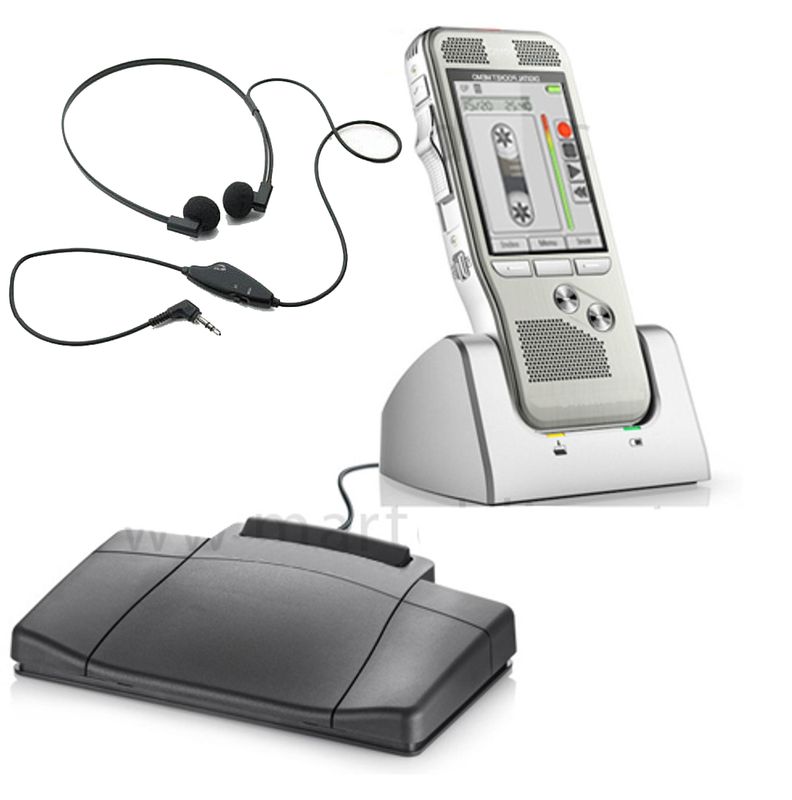
For an authorized backup recording, choose a recorder and playback path you can operate under assignment conditions. Martel's Digital Court Reporter 5000 records WAV or MP3. The Recorder + Transcriber package includes the recorder, cradle, foot pedal and headset. A reporter who wants to check a phrase at a desk can test that complete path in advance. Compare the package contents when choosing a configuration, particularly if you already own the recorder. Digital Court Reporter 5000 recorder and transcriber
During a rehearsal, also stop between two sentences and start a second file. Ask the reviewer to find the first words after the restart. It takes little time and uncovers two expensive problems early. One is an unexpected reset of the elapsed time display. The other is a file name that gives the reviewer little idea which portion of the proceeding it contains.
Meet the witness and mark a listening map
This deposition is entirely fictional. Mira Vale is a receiving clerk at Orchard Row Supply. Ali Rowan asks the questions. Jo Kent is the other attorney present. The disputed delivery took place at a loading gate. A paper receiving ticket is used in the examination. The names, document, times and dialogue were created for this exercise.
Imagine that the reporter has a working draft, one authorized audio file called Part A, an attendance note and the marked ticket. At the beginning, the witness states her name and spells her surname. At the exhibit introduction, the reporter makes a short note. A cart rattles past the door as Vale later describes checking the gate. These scraps of independent information are enough to test several decisions without assuming anyone remembers the entire exchange.
| Elapsed position in Part A | Event a reviewer can find |
|---|---|
| 00:54 | Mira Vale identifies herself and spells her surname. |
| 02:14 | Rowan identifies the paper as Exhibit Seven. |
| 02:38 | Vale reads the separate ticket number printed near the fold. |
| 03:06 | A cart masks one word in Vale's answer about the gate. |
| 03:18 | Rowan asks which part she checked. Vale names it and explains what she did. |
Each entry tells the reviewer what to expect when playback starts. A list of five bare numbers would require opening each position to discover which one matters. Conversely, “the part where Mira talks about the truck” sends a listener hunting through the whole examination. A file label, elapsed position and short verbal landmark usually fit on one line.
The map has limits. Nothing in it establishes what the cart covered at 03:06. Jo Kent's name on the attendance note establishes presence in this exercise. It does not assign Kent every voice that sounds different from Rowan. Use each source for the particular fact it supports. That habit also makes a small file map useful on a much longer job.
Build a first pass around the turns of speech
Begin by listening through a complete question and answer at ordinary conversational speed. Find the point where the questioning voice gives way to the witness. On a first pass, that boundary may matter more than whether counsel said “this ticket” or “the ticket.” A reporter can revisit a short phrase. Recovering from a whole paragraph attributed to the wrong person involves more work.
In the practice exchange, Rowan asks Vale to state her name. Vale answers, “Mira Vale. V as in violet, A, L, E.” The attendance note confirms the spelling. The witness has supplied both the name and a spelling instruction. If the assignment calls for a verbatim rendering, the spelling belongs in the testimony in the applicable style even after the heading is correct. There is no need to expand the text with information the witness never gave.
Later, Rowan says, “I've marked this receiving ticket as Exhibit Seven. Where is the printed ticket number?” Vale answers, “Near the fold, under my initials.” Rowan then asks, “Will you read that number?” Vale says, “Seventeen.” Listen from the introduction through that last reply. Taken in isolation, the one-word answer could easily be attached to a question about the exhibit mark.
For a first working pass, give an unresolved phrase a conspicuous internal reference the reviewer knows how to find. Continue far enough to keep the examination intelligible. When the order of speakers itself is uncertain, put a marker at the turn as well. This keeps a plausible first impression from hardening into an attribution simply because the next editor encounters it in an otherwise polished paragraph.
Read the excerpt the way a reviewer would
The following is a shortened working excerpt from the invented deposition. The square-bracketed review item is a private editing cue for this example. Use the format prescribed for the assignment when preparing an actual transcript. The elapsed times belong to the review map above and do not imply a requirement to print them on a page.
Q. I've marked this receiving ticket as Exhibit Seven. Where is the printed ticket number?
A. Near the fold, under my initials.
Q. Will you read that number?
A. Seventeen.
Q. Did you close the gate before the truck left?
A. I checked the [review item 03] before it left.
Q. What part did you check?
A. The latch. I didn't close the gate.
Read the excerpt aloud once, then look away and describe what happened. A reader who says, “She closed the gate after looking at ticket seven,” has reversed the force of the last answer and confused the two numbers. The check is to trace each proposition back to its own line. Vale read a ticket number. She described checking something before the truck left. She later named the latch and denied closing the gate. The first word under the cart noise still needs a decision.
Now put the marked ticket beside the excerpt. In this exercise, the exhibit sticker reads “7” and the printing near the fold reads “17.” The physical document corroborates the distinction between the markings. It does not authorize expanding the witness's answer “Seventeen” into “The ticket number is seventeen.” The earlier question already tells the reader which number she means. A draft can become less faithful while becoming easier to skim.
Look also at the contraction in “I didn't close the gate.” Dropping two letters would change what the witness said about her own act. Listening for the negative at the end of this short run is a much more specific editing task than playing the whole file louder and hoping errors stand out.
Resolve the exhibit number where the ambiguity begins
A common place to look for a numerical error is the figure itself. In this example, the most efficient place to begin is the preceding noun. Rowan calls it an exhibit when pointing to the mark and a ticket when asking about the preprinted identifier. The change in noun explains why the two numbers can coexist. Check enough continuous speech to hear that transition.
If an exhibit list calls the document “receiving ticket” and the witness calls it “the slip,” the reviewer has two jobs. Use the assigned document title where an index calls for it, and preserve the words the witness used in the answer. Replacing “the slip” throughout the testimony with a formal title introduces a precision the speaker never expressed. A note in the review log can explain why two descriptions refer to the same sheet.
Imagine a different rehearsal in which the sticker is hidden by a binder clip and the audio introduction is faint. “17” remains legible on the body of the paper. That single fact establishes the printed ticket number and leaves the exhibit designation open. The appropriate next inquiry concerns the marking record or the responsible reporter's note. Reading the printed figure a second time supplies no additional evidence about the sticker.
Keep the first mention, subsequent references and exhibit index among the places you check after resolving a number. Use a targeted search for the term or designation as an aid. Read each result in its sentence before changing anything. The practice transcript contains a correct “Seven” and a correct “Seventeen.” An indiscriminate replacement can undo a careful comparison in one keystroke.
Give an unclear answer a fair hearing
At Part A 03:06, begin playback before “Did you close the gate.” Hear the whole question and answer with headphones. Locate the start and end of the masking sound. In the exercise, “I checked the” and “before it left” are intelligible. What disappears is one short word between them. That distinction gives the reporter a much more precise issue than a note saying “answer unintelligible.”
Make a second pass for a different purpose. If the authorized recording has distinct sources on separate channels, listen to the one that carries the witness clearly, then return to the combined sound to check order and context. If there is only one room mix, look at the reporter's notes or an authorized second recording, if available. If a particular adjustment yields no new speech information, log the result and spend the next minute on a different source.
Now listen to the follow-up at 03:18. Vale clearly says “The latch.” That supplies the answer to Rowan's second question. It also makes “latch” an attractive guess for the missing word in the first answer. Vale might have said “hinge,” “hook” or another term before clarifying herself. A listener who sees a suggested word in the draft can hear the same muddy sound quite differently. Give the reporter the later reference and leave the uncertainty in the earlier answer visible.
The next action belongs to the responsible reviewer under the assignment's procedure. They may have contemporaneous notes or another permitted source that resolves the earlier word. If the evidence remains insufficient, they can determine the applicable treatment for that position. The working copy has done its job when it specifies the remaining gap accurately and preserves every word on either side that can be supported.
Set up headphones and a foot pedal for this job
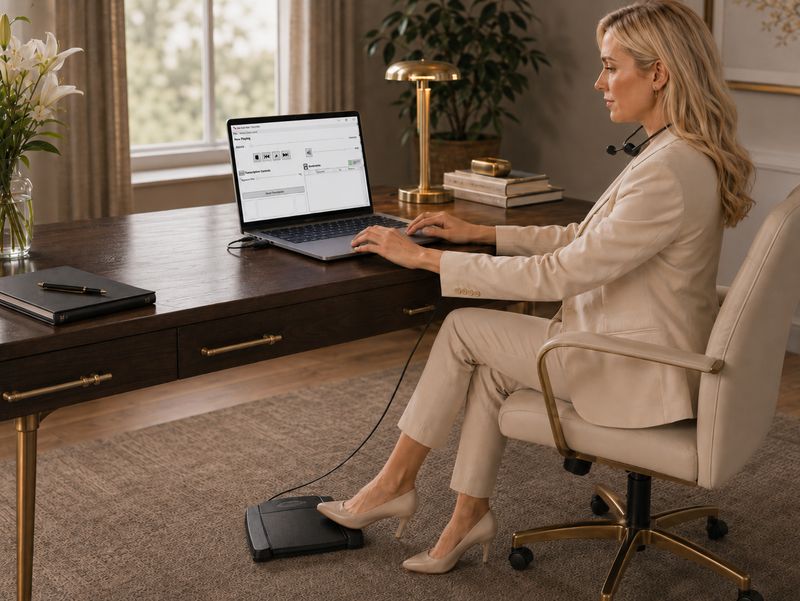
The most useful playback station is one that can return you to the beginning of the same question with both hands still on the keyboard. Put the pedal where the heel rests comfortably and test its controls on an ordinary sentence. Check what happens when you press, hold and release. Some configurations resume slightly before the stopping point. A long automatic backstep can carry you through the end of the previous answer each time you lift your foot.
For a practical pedal test, play “Did you close the gate before the truck left?” Release after “gate” and enter the words you heard. Resume and listen for the transition into “before.” If the opening words after release vanish, inspect the restart behavior or the position you selected. If you repeatedly hear almost the entire question, adjust the backstep where your player permits. Once it feels predictable, test again with the typing window active. Martel transcription foot pedal compatibility guide
Start headphones at a comfortable level and check an easy passage first. In the exercise, Vale's spelled surname should be intelligible before you concentrate on the cart noise. Listen to both earpieces. If your program offers source selection, learn which recorded channel is routed to each control. Hearing the same sentence in both ears can simply mean the player sends the same signal to both. It tells you little about how many independent sources were recorded.
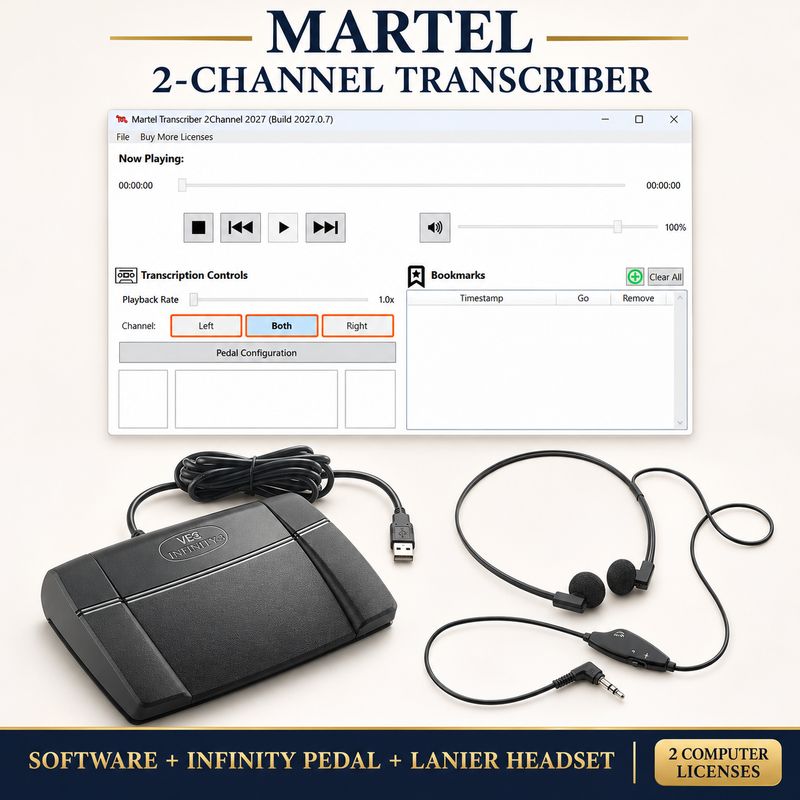
Match the equipment to the actual file. For ordinary supported recordings in a separate computer player, Martel's All N One Digital Transcriber includes a USB pedal and headset and offers adjustable playback speed and backspace. For material with distinct signals recorded on the left and right, Martel's 2-Channel All-in-One Transcriber Kit offers left, right or combined playback. If the voices already occupy one mix, selecting a side cannot recover them as separate tracks. All N One Digital Transcriber · Martel 2-Channel All-in-One Transcriber Kit
Give the scopist an editable copy and a question they can answer
For a stenographic deposition, a scopist can compare the reporter's shorthand with the translated text. That skill is particularly valuable when a translation produced a real word that fits the grammar but sounds wrong in context. The person receiving a standalone recording and transcribing it from scratch has a different starting point. In either arrangement, agree on the sources that belong to the assignment and who will make decisions about remaining questions. National Court Reporters Association on the work of a scopist
Keep a clearly identified source recording and work in the designated editable transcript copy. Give the copy a distinct revision identifier. If the reporter is working elsewhere in the same job, specify the section the scopist owns and how its boundaries can be recognized. “From Rowan's exhibit introduction through Vale's final gate answer” survives a change in page breaks better than “the bottom of page four.”
A useful entry about a hard word tells the next person exactly where to start, what remains unclear and what has already been checked. “Part A, 03:06, between ‘the’ and ‘before it left.’ Cart obscures noun. Later at 03:18 Vale names the latch. Please check your corresponding notes.” A listener can now spend their first minute testing a genuinely different source. They can also disagree with a proposed reading without rebuilding the whole sequence.
| Working item | What the scopist records | What the reporter can check next |
|---|---|---|
| Witness identification | Part A 00:54 includes Vale's spelling. Heading and introduction agree. | Confirm the same spelling at each later speaker reference. |
| Exhibit reference | Part A 02:14 and 02:38 distinguish mark 7 from printed ticket 17. | Compare the exhibit entry with the actual mark. |
| Obscured testimony | Part A 03:06 contains one unresolved noun. The later answer remains clear. | Check the notes for the earlier answer and determine its treatment. |
Keep resolved items separate from open items in whatever log the reporter uses. A new reviewer should be able to see that no one needs to investigate the exhibit number again unless fresh evidence changes it. At the same time, no one should have to infer from an empty comment whether the masked word was actually resolved or simply overlooked.
Check the finished working pages against the sound
The moment to look for lost content is after editing has changed the shape of the page. Set the working copy aside for a moment and listen to the whole gate exchange. Count the speaker turns. Then follow the text while the recording plays at a comfortable rate. A short answer can slip into a question during a paragraph merge. Hearing four turns while seeing three gives you a concrete reason to stop.
For this excerpt, check four details in succession. Vale locates the ticket number near the fold. She reads it as seventeen. Rowan uses “before” in the question about the truck. Vale uses “didn't” in the follow-up. Checking only the long nouns might confirm the entire story in broad outline while missing a reversal in timing or responsibility. Search a document for repeated phrases when helpful, but scan the words immediately before and after the match.
Next, open the actual review copy as its recipient will see it. Does the display retain speaker labels after a page break? Can the reviewer locate the one open question? Does the exhibit entry refer to the correct number? If there is both a native working file and a rendered reading copy, compare one distinctive line in the middle and the final line in each. An earlier export can have the proper name and job title and still omit the last revision.
Keep the review status visible outside the testimony. A short accompanying note for this exercise could read, “Mira Vale working copy, revision two. Exhibit 7 and printed ticket number 17 checked. One open word in Part A at 03:06. Later answer at 03:18 is clear.” That message explains exactly what another reader can rely on and where the reporter still has work to do. Formal completion follows the process for the job.
Try the workflow with a second reader
Make a paper ticket for a rehearsal. Put the number 17 beside a fold and mark the corner as Exhibit 7. One person can read Rowan's questions while another plays Vale and turns the paper. Record only this invented exercise. Have a separate listener prepare the four exchanges from the recording, then hand that person the paper and ask which lines it helps them check. The spoken and printed evidence should answer different questions.
For a second round, leave the paper in place and change just one spoken fact. Vale might say, “Beside the fold,” where she originally said “near the fold.” A careful reviewer should find the change even if both versions make sense. If they report the agreement between seven and seventeen while missing the change in wording, ask them to listen once without the paper. The first reading may have directed too much attention toward the numbers.
Finally, start the exercise from a different file position and have a colleague locate the uncertain line from your notes alone. If they land on the word “latch” in the later answer, check whether your locator includes the opening words of the earlier question. The measure of an adequate note is whether a fresh listener can independently arrive at the same event. This is easy to practice on invented dialogue and difficult to improvise under a deadline.
Questions and answers about deposition audio transcription
1. What should I ask for when a deposition recording arrives without a draft?
Start with the authorized assignment instructions, file sequence and whatever contemporaneous speaker and exhibit information the responsible reporter can provide. Open the first file and see whether it contains introductions. If it begins in the middle of a question, ask about the apparent missing beginning before assigning speaker labels. Confirm the expected output as well. A document for the reporter to edit has different production needs from a time-coded internal listening log.
2. Can stenographic notes help when both lawyers sound alike?
Yes. A reporter may have marked a change of questioner in the notes or recorded the name in a job log during the examination. Find a passage where an attorney identifies themselves, compare it with the turn in question and consult any contemporaneous notation for that moment. If the sources conflict, flag the exact turn. A guess based on the speaker's tone becomes harder to detect after their name appears on several consecutive paragraphs.
3. How can a quiet witness be checked without interrupting testimony for an equipment test?
Use a test voice in the witness's position before the proceeding when the assignment and room permit it. Include an answer spoken while facing a document. During authorized recording, observe whether the established input continues to register and follow the reporter's procedure if testimony becomes difficult to hear. Wait until an appropriate opportunity to make physical changes. Moving a microphone mid-answer can itself obscure the word you wanted to capture.
4. Does a moving recording meter confirm that the witness is intelligible?
The meter indicates signal activity. It might respond to the near attorney, a chair moving or noise from a ventilation grille while a distant witness remains indistinct. A useful playback test asks a listener to repeat the witness's last few words without seeing the test script. If they can repeat counsel's question but miss the witness's answer, examine pickup position and the source selection before proceeding.
5. Why open the saved test when monitoring sounded fine?
Monitoring can establish that a voice reaches a listening point. Opening the saved file answers another question. Did the selected recording input, routing and file actually retain that voice? Also check that the file opens in the intended playback application. The combination matters when one device captures the proceedings and a different workstation performs the transcription. A spoken file label at the start of a rehearsal makes it easy to identify the test you just made.
6. Will a second recorder help with a word lost in the main recording?
It can if the second recording was authorized and its microphone captured a more intelligible version. Find the same complete question on both recordings before comparing the answer. Their elapsed times can differ because the devices started at different moments. A second device next to the first may hear the same cart with equal clarity. Judge what each source captured by listening, and record which source supported the eventual reading.
7. Should I convert a recording to a new format before transcribing it?
First check whether the assigned player can open the existing authorized work file. Conversion can add a needless step and may affect channel layout, depending on the export settings. If the assignment requires a derivative, keep the source identified and compare the beginning, a middle passage and the ending. For multichannel material, verify at a recognizable moment that the individual channels you expect remain available to the reviewer.
8. What if two separate files both have a time of 03:06?
Make the file identity part of the reference. “Part A, 03:06, question beginning ‘Did you close the gate’” identifies a moment much better than a timestamp on its own. After a recess, a new file may restart at zero. A separate label for that file also protects the reference when the document is repaginated and a hard word moves from one page to the next.
9. How can I tell whether a two-channel file actually separates sources?
Use a passage with a readily identifiable sound from each source. For example, an authorized practice file could contain a spoken test phrase on one input and a different phrase on the other. Select each channel in the player and note what you hear. Two channel indicators can both carry the same room mix. An isolated but faint copy of a room sound can also reflect pickup by more than one microphone.
10. Is slower playback always better for a fast answer?
Try slowing only enough to locate the syllables or speaker change you could not follow. Return to ordinary speed for emphasis, the end of the phrase and its relation to the next speaker. Excessive slowing can make natural speech harder to recognize. In the practice example, a moderate change can help locate the edges of the cart noise. Changing speed does not supply speech that the recording failed to retain.
11. How do I choose headphones for long stretches of deposition review?
Try them with the actual playback connection and a short speech passage containing a quiet ending. Listen at a comfortable level and type while wearing them. Check whether cable position, fit or an intermittent plug distracts you from the words. A suitable headset lets you follow speech reliably and hear the intended channel arrangement. The right connector and comfortable fit often settle the choice before more elaborate features matter.
12. Can I use a transcription pedal with the recorder and my laptop?
Check the exact pedal, recorder or cradle, operating environment and application separately. A control intended for a dedicated recorder setup and a USB pedal intended for a computer player can have different connections and requirements. If the work will move between stations, test both configurations with a practice file and verify all controls. The connector shape alone cannot establish that an application recognizes the desired commands.
13. What if the pedal works until I click into the transcript?
Reproduce the behavior with an invented sentence. Press play with the player visible, click into the working document and press the same control again. If the behavior changes only when the document is active, check the player's supported control settings and the documentation for your specific combination. A pedal that works only with the pointer inside the player will interrupt typing even though it passed the first connection test.
14. How long should an automatic backstep be?
Use a length that restores the last few words you need to recognize your place. The right setting depends on the speaker's pace and how often you pause. Test a full exchange as well as a one-word answer. A comfortable backstep in a long narrative can send you into a different speaker's turn during rapid questioning. Where available, choose a setting that makes both boundaries easy to identify.
15. How can a reviewer check two nearly identical surnames?
Look for the moment each person identifies themselves, then compare it with the authorized attendance material or other contemporaneous source. Record which spelling belongs to which role. During proofreading, search for both spellings and read the surrounding turn. A correctly spelled surname can belong to the wrong person. In the exercise, “Vale” and “Vail” would sound alike, but the witness settles her spelling on the recording.
16. What belongs in an exhibit index when the witness uses a nickname for a document?
Use the prescribed exhibit description and the supported designation in the index. Preserve the witness's spoken description in the testimony. Track the connection in a working note if needed. Suppose the index identifies a receiving ticket and the witness calls it “my yellow slip.” A reviewer can verify both references refer to the marked sheet without rewriting the quoted phrase or silently assigning a new title to the exhibit.
17. What should I do when the audible number and the printed number differ?
First determine whether they identify the same thing. A sticker, a page number, an invoice number and a quantity might all appear on the sheet. If the witness really does read a number differently from the document, record what the witness said and flag the discrepancy for the responsible reporter. A legible figure on paper is evidence about the paper. It cannot establish that the speaker pronounced the matching figure.
18. How do I show that a witness corrected an answer mid-sentence?
Listen through the complete thought and identify both the initial statement and the correction. In a practice sentence such as “It was the north door, sorry, the loading door,” the listener heard two descriptions and a correction between them. Follow the authorized style for punctuation and interruptions while keeping that sequence recoverable. Replacing the whole answer with only the last description would conceal information a reader of the testimony may need.
19. What if a speaker stops before finishing a question?
Listen for the next turn and for any continuation after it. A pause followed by the same person's remaining words may call for a different treatment from an unfinished question that counsel abandons. Mark the boundary according to the assignment's conventions. Avoid inventing the rest of a sentence just because its likely ending seems obvious. If another voice enters during that boundary, check attribution and punctuation as separate issues.
20. How should a reviewer approach two people speaking at once?
First establish when each voice begins. Replay the lead-in, identify any phrases that remain independently intelligible and use distinct recorded channels if available. If one person resumes a sentence after the overlap, that continuation may help place the start of their turn. It cannot establish every word during the collision. Tell the responsible reporter which voice and which stretch remain uncertain so the problem receives the right treatment.
21. Can the later clear answer fill an earlier inaudible word?
Use the later answer as context and log its location. Then look for independent support for the earlier word. A witness can narrow a description, choose a more precise term or correct a prior statement when asked again. In the Vale exercise, “The latch” belongs in the response at 03:18. The answer at 03:06 needs support from its own audio or another permitted source for that particular passage.
22. What is a good way to record an uncertainty without biasing the next listener?
Identify the source, place and boundaries first. Explain what masks the word and record any other references separately. If the reporter wants an independent listen, leave a guessed word out of the first prompt. “Between ‘the’ and ‘before,’ under the cart noise” gives another person a place to start. You can then discuss the later reference or candidate words after they have heard the original passage for themselves.
23. Can an editor correct grammar that makes a witness sound awkward?
Follow the transcript requirements and preserve the words and meaning of the testimony. Punctuation can help a reader follow the sequence of a fragment or restart. Substituting a more polished verb can change what the witness actually said. When the uncertainty is about the spoken word, go back to the corresponding source. When it is about how to represent a clearly spoken construction, consult the applicable style instruction.
24. How can punctuation change the sense of a short answer?
Consider “No, I checked it” and “No. I checked it?” Both use the same words and can give a reader different impressions of the witness's certainty and response. Listen to the full question, the cadence and any immediate continuation. Choose punctuation under the assignment's conventions. If the performance leaves genuine ambiguity, avoid supplying extra explanatory words just to favor one reading of the answer.
25. Which facts deserve a separate accuracy pass before the review copy goes out?
Look for details that switch the answer when omitted or changed. Negatives, directions, units, counts, dates and words such as “before” and “after” are good candidates. Choose the details actually at issue in the testimony. For Vale, the efficient pass checks the role of the number seventeen, the location of the printed figure, the timing of the truck's departure and her denial that she closed the gate.
26. Is a printed page and line number enough for an editor's query?
It can be useful on a fixed review copy. Add a short quotation and a file position when the job allows it. Pagination can change between revisions, and some displays hide line numbers. A query that identifies Part A, the gate question and the words before the gap remains useful if a new introduction adds several pages. Keep the reference short enough that a colleague can read it while operating playback.
27. How can I check I am editing the current transcript revision?
Look for the assigned revision identifier and a known changed passage. In the practice file, the later working copy could contain a verified distinction between exhibit and ticket, while the first copy still has a question about the numbers. Confirm you can see that change before spending an hour editing. File modification time alone can be misleading if a copy was duplicated or exported after the real editing work.
28. What can a scopist resolve from a translated draft alone?
A scopist can spot many apparent formatting or consistency issues in the text. A choice between two plausible translated words requires evidence about what the reporter wrote or the witness said. The working draft might read “She locked the gate” and make grammatical sense. If the question is whether Vale said “checked” or “locked,” the reporter's shorthand, authorized audio and the exact assignment determine the next step.
29. When is an internal note ready to be closed?
Close it when the person authorized for the decision has recorded the outcome and the correct working copy reflects it. For the exhibit query, compare the audio introduction with the marked ticket, verify the relevant text and update the log. For the cart noise, recording that a later answer names the latch is only a finding. Keep the earlier query visible until the responsible reviewer has determined its disposition.
30. What tells me a deposition transcript is ready for the reporter's final review?
The reader can identify the witness and speakers, trace exhibits, account for the beginning and end of each assigned section and locate each open issue. Confirm the review copy is the current one and that any accompanying issue list points into that version. In this exercise the reporter should be able to find the earlier gate answer on the first attempt and see immediately why the later, clearly spoken answer was preserved.
Sources and further reading
- For the federal rules governing oral depositions, see Rule 30 in the Federal Rules of Civil Procedure.
- For the role of a scopist in reviewing a reporter's shorthand and transcript, see the National Court Reporters Association's description of scoping.
- To match a playback arrangement to the assigned files, consult Martel's transcription kit guide for court reporters and scopists.
- For supported recording formats and equipment package contents, refer to the Martel Digital Court Reporter 5000 configurations.
This guide and its fictional deposition are for educational purposes only.