Stenomask voice writing and stenotype writing use different input methods to help a trained professional create a record of spoken material. A voice writer speaks into a mask microphone. A stenotype writer uses combinations of keys on a specialized machine. Both involve much more than owning the input device: listening, preparation, terminology, review, and the requirements of the intended work remain central.
The useful comparison is therefore not a contest between a mask and a keyboard. It is a comparison of complete learning and working methods. Which method is supported by the program you are considering? What equipment and software does it require? How will you practice, evaluate progress, and prepare the finished work? Those questions tell you more than a promise that one route is universally easy, fast, or inexpensive.
This guide offers a practical decision framework and original scenarios for students and professionals exploring their options. For readers investigating voice writing equipment, it also shows all seven Martel stenomasks with purchase links. It does not promise qualification, a completion date, earnings, or a particular performance outcome from either method.
Understand the input difference
In voice writing, the reporter listens and repeats the spoken material into a mask using the method taught for the workflow. The microphone carries the reporter's voice to compatible equipment. Recognition software may convert that input into text, while the surrounding reporting process organizes and reviews the work.
In stenotype writing, the writer enters combinations of keys on a specialized machine. NCRA's explanation of stenographic writing describes a compact keyboard used in combinations to represent speech. The input is not ordinary letter-by-letter typing on a standard computer keyboard.
That difference shapes practice. A voice writing learner works with listening, repetition, mask technique, and the chosen software process. A stenotype learner develops the taught writing theory and machine input skills alongside listening and text production. Neither route removes the need to understand what the record should contain.
Begin by observing a complete demonstration of each method through a credible educational source. A short clip of someone speaking into a mask or pressing keys can show the physical action, but it cannot reveal every step required to produce and review the finished work.
Compare the complete path from speech to usable work
For either method, trace the workflow in order. Original speech must be heard. The reporter must capture it through the chosen input method. Software may translate or recognize that input. The resulting material must then be reviewed and prepared for its intended use.
Ask what evidence is available at each stage. In a voice writing practice exercise, a mask recording can help show what the learner repeated. In a stenotype exercise, the recorded writing and translation process provide a different basis for review. The instructor should explain how students locate and correct errors within the chosen system.
Also ask which additional recordings are part of the approved arrangement. A room recording, when appropriate and permitted, is a different source from the reporter's mask voice or machine input. Do not assume that buying either input device supplies a complete original-room recording system.
The central comparison is how you will learn to move from an imperfect attempt to a better one. A method becomes more understandable when you can see where an error occurred and what the next practice task should address. Equipment specifications alone do not explain that feedback process.
Separate a method decision from a product decision
Choosing a reporting method comes before choosing a particular mask model. A person comparing educational routes does not yet have enough information to select an input solely from a product price. Program support, software requirements, practice resources, and the intended work all help define the equipment decision.
Once a voice writing arrangement is established, the product question becomes more specific. Do you need direct USB? A compatible 3.5mm microphone path? Two independent destinations? An XLR input? Those are model-selection questions inside the broader method decision.
The same distinction helps an experienced professional considering a transition. Existing listening and review skills may be valuable, but a different input method and software arrangement still require learning and testing. A new device should not be treated as a complete transition plan.
Keep two separate lists: questions about the method and questions about the equipment. This prevents a persuasive product feature from answering a question it cannot settle, such as whether a particular training program suits your schedule or whether the method is accepted for the work you intend to pursue.
Compare training support before comparing marketing claims
Ask each prospective program to describe the curriculum, equipment requirements, feedback process, and expected practice structure. Request specifics about how progress is evaluated and what support is available when a student repeatedly struggles with a particular task.
For voice writing, NVRA's education resource lists programs to investigate and explicitly notes that listing is not accreditation or endorsement. Use a directory as a starting point for your own questions, not as a substitute for evaluating the program itself.
Useful questions include whether demonstrations use the same software students will operate, how instructors review submitted work, and how equipment problems are separated from skill problems. Ask what happens when an input device changes or a student needs help reproducing the approved configuration.
Avoid choosing a method solely from a headline completion time. A stated timeline may depend on assumptions about prior experience, weekly practice, attendance, and progress. Obtain the actual conditions and evaluate them against your circumstances. A realistic training plan should make the work visible rather than imply that purchasing the recommended equipment completes the difficult part.
Design a fair introductory comparison
If you can observe or try both methods through an appropriate program, use comparable learning conditions. A few minutes with an unfamiliar stenotype keyboard cannot fairly be compared with ordinary speech into a microphone, because those activities do not represent equal training in the professional methods.
Instead, ask for an introductory exercise designed by each instructor, an explanation of its purpose, and an example of how feedback improves the next attempt. Note which aspects you understand, which demand practice, and what support would be available. The comparison should reveal the learning process rather than manufacture an instant winner.
Keep a short reflection afterward. Describe the task, the difficulty, and the feedback you received. “I understood how to locate the missed phrase after the instructor's review” is a useful observation. “This felt easier in five minutes” is much less predictive of a sustained course of study.
Do not use a single informal trial to make broad claims about either profession or method. Its purpose is to help you ask better questions and decide what further investigation you need before committing time and money.
Compare physical work without making medical assumptions
The methods involve different physical actions. Stenotype writing uses a specialized keyboard. Voice writing involves speaking into a mask and managing its position while listening and working with the computer. Those differences are relevant to workstation planning, but they do not justify a universal claim that one method is comfortable or medically suitable for everyone.
During an appropriate supervised introduction, observe practical details: how the equipment is positioned, where the screen sits, how cables are routed, and how the user changes tasks. Ask what support accessories or workstation arrangements are used and why.
For voice writing equipment, a stand or other compatible accessory may be worth investigating when it addresses a specific positioning need. Do not assume an accessory eliminates every source of discomfort or replaces an individualized assessment when one is needed.
Record your observations in concrete terms. “I kept moving the mask to reach the keyboard” suggests a workstation question. “I could not see the screen comfortably in that arrangement” suggests another. These observations are more useful for choosing and adjusting equipment than a blanket statement that one input method is inherently easy on the body.
Compare costs using complete configurations
The price of a mask and the price of a stenotype machine are not complete educational budgets. Each route can involve a computer, software, instruction, support, and other required equipment. Existing suitable items may reduce the additional purchase. Required licenses or interfaces may increase it.
Ask each program for a current itemized equipment list and identify what is mandatory, optional, or available through an approved alternative. Record what is included in tuition or a package and what must be purchased separately. Do not compare one program's full package with another method's bare input-device price.
Separate one-time purchases from recurring charges and from uncertain future costs. The purpose is a transparent comparison, not a prediction that every learner will spend the same amount. Use current written offers for the actual configuration under consideration.
Also account for the time needed to set up and learn the system. A lower purchase total may still require an unsupported configuration that consumes extra effort. A higher total is not automatically justified either. Ask what capability or support the difference buys and whether it matters to your defined learning plan.
Understand what software contributes
Software helps turn the input into usable text and supports the surrounding workflow, but its role differs with the selected system. In voice writing, recognition software interprets speech from the chosen microphone path. In a stenotype workflow, the writing is translated through the supported system and its taught conventions.
Neither description means the application independently understands every speaker, resolves every ambiguity, or removes the need for review. Ask an instructor to demonstrate an error and its correction, including how the student identifies where the problem arose. That example is more informative than a perfect prepared demonstration alone.
Confirm the exact software versions and supported integrations before purchasing. A familiar brand name does not establish that a particular license, operating system, or component combination meets the program's requirements. Avoid assuming that a microphone product name includes software or that an existing license can automatically be reused.
Keep the application decision tied to the curriculum and intended work. Selecting software first because of a promotional price can create a mismatch that the input-device purchase cannot solve later.
Consider realtime work as a separate capability to develop
Seeing words appear on a screen can be an exciting demonstration, but it does not prove that the output is ready for every realtime use. Ask what the receiving audience needs, what the supported software arrangement provides, and how the learner's work is evaluated for that purpose.
A practice transcript that can be carefully reviewed later presents different demands from text someone relies on as it appears. Names, numbers, speaker handling, and correction workflow deserve attention. Do not assume that a new microphone or machine automatically supplies the skills and integration needed for a particular service.
When comparing programs, ask how they introduce realtime tasks and how they distinguish input speed from usable output. Request examples of the feedback students receive and the prerequisites for advancing to more demanding exercises.
This is not a reason to avoid either method. It is a reason to define the desired service accurately. A concrete goal produces better questions about training, software, equipment, and evaluation than a general promise that the system “does realtime” without describing the conditions or expected result.
Examine three original decision scenarios
Imagine a new student choosing between two programs. One provides a clear curriculum, current equipment requirements, and regular individual feedback. The other advertises a faster path but leaves the practice structure and software support unclear. The student's next step is to obtain the missing program information, not to assume the input method associated with the shorter advertisement is automatically better.
Now imagine an experienced stenotype professional exploring voice writing for a different work arrangement. The professional may already understand listening, terminology, and review, but still needs to learn mask input and the supported recognition process. A sensible investigation includes a transition curriculum and a verified equipment plan. It does not assume that existing experience eliminates every new skill.
Finally, imagine a voice writing student whose first tests produce poor text. The student considers switching methods immediately. Before making that decision, the instructor checks the captured audio and discovers that the application was using the computer's built-in microphone. Correcting that equipment selection allows a meaningful evaluation of the student's actual practice. The example is hypothetical, but the reasoning matters: a configuration failure should not be mistaken for evidence about an entire method.
Each scenario separates the source of uncertainty. Program support, transition learning, and equipment routing are different questions. Identifying the right question prevents a large decision from being driven by a small but unresolved misunderstanding.
Map voice writing requirements to the seven Martel models
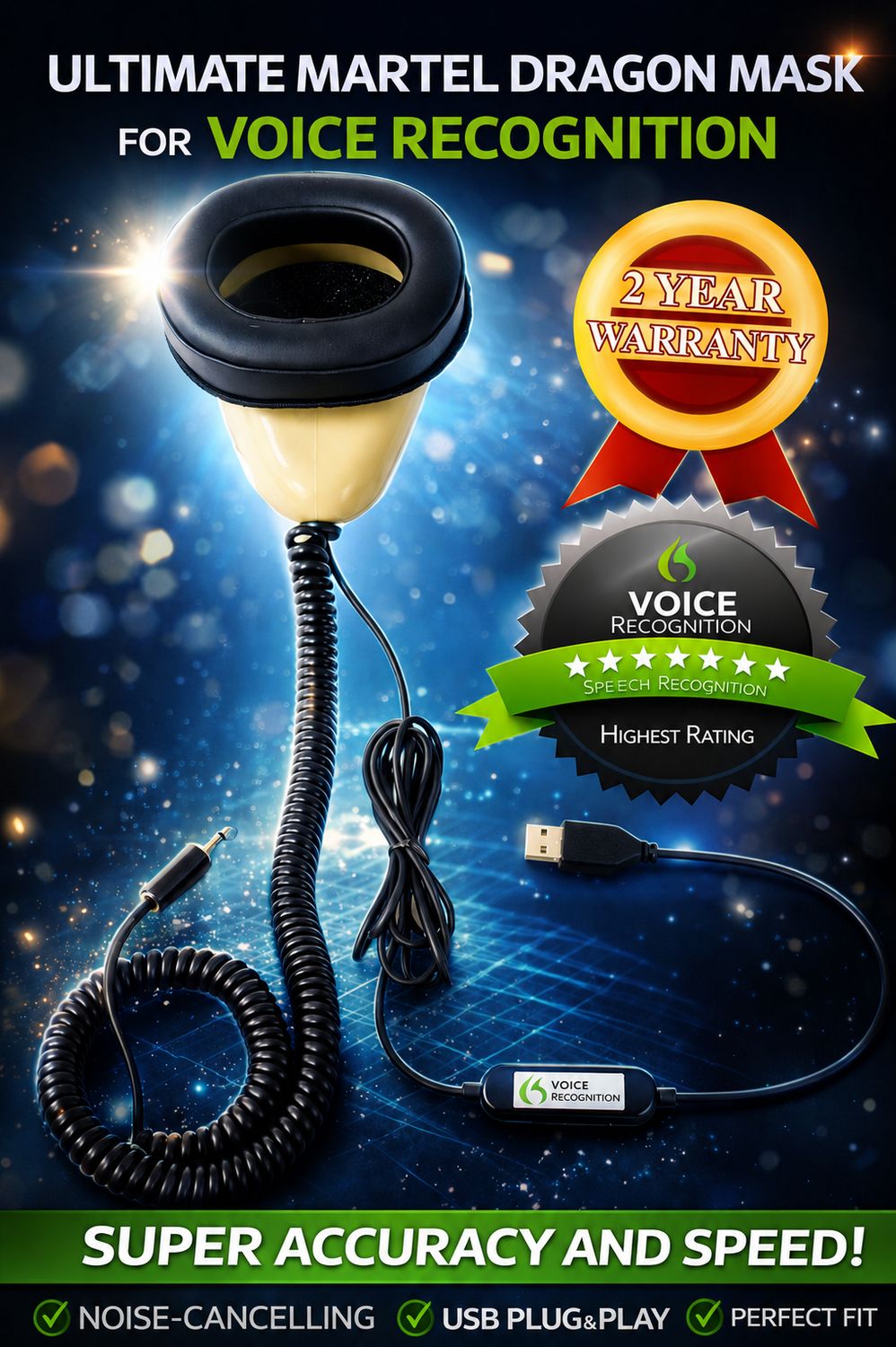
Once you have chosen a supported voice writing arrangement, use the connection requirements to narrow the hardware options. The table below includes all seven Martel stenomasks and links to their actual product pages. Current price, availability, and package contents should be checked on the individual listings.
| Model / purchase page | Connection arrangement | Current offer |
|---|---|---|
| Double Dragon 2 — view product | USB plus a separate 3.5mm microphone output | Open the product page for price, contents, and availability. |
| Dragon Stenomask — view product | Direct USB; one computer microphone path | Open the product page for price, contents, and availability. |
| MM-ST1 — view product | Two independent 3.5mm microphone outputs | Open the product page for price, contents, and availability. |
| MM-ST2 — view product | XLR plus a separate 3.5mm microphone output | Open the product page for price, contents, and availability. |
| MM-18 — view product | One 3.5mm microphone output | Open the product page for price, contents, and availability. |
| MM-XLR — view product | One XLR microphone output | Open the product page for price, contents, and availability. |
| MM-14 — view product | One 1/4-inch output; not compatible with Andrea or USB sound cards | Open the product page for price, contents, and availability. |
The MM-18 serves a single compatible 3.5mm microphone path. Dragon Stenomask provides direct USB. Double Dragon 2, MM-ST1, and MM-ST2 offer different two-path arrangements. MM-XLR and MM-14 address specific receiving-input requirements. Martel identifies MM-14 as incompatible with Andrea or USB sound cards.
This comparison does not rank the methods or claim one mask makes someone a better reporter. It connects a defined equipment requirement to a relevant product listing. For the full selection, browse Martel's stenomasks. For a broader system, review voice writing equipment and accessories.
Build a decision worksheet around evidence
Create a row for each issue that affects your choice: program schedule, practice expectations, instructor feedback, required equipment, software support, intended work, and total known cost. For each method, record a confirmed answer or an open question. Do not turn missing information into an assumed advantage.
Use notes instead of an arbitrary overall score when the evidence is incomplete. A numerical rating can look objective while merely converting guesses into arithmetic. For example, mark “feedback frequency not yet confirmed” rather than awarding a low score based on an unanswered email or a brief webpage description.
Identify the next action beside every open question. It might be a program demonstration, a written equipment list, a conversation about a transition course, or confirmation from the relevant receiving organization. This turns the comparison into a manageable investigation.
When enough information is available, explain the decision in ordinary language. “This program supports the method I want to learn, fits my schedule, and provides a confirmed equipment arrangement” is a defensible reason. “The device looked easier online” leaves most of the important questions unanswered.
Plan the first month around observable learning tasks
After selecting a program, use its curriculum to define the first learning tasks. Establish the approved equipment setup, complete the introductory exercises, and learn how to review mistakes. A calendar filled with vague intentions to practice is less useful than a sequence of tasks with clear feedback.
For a voice writing setup, an early equipment milestone might be a clear saved mask recording and a verified application input. An early learning milestone might concern the instructor's method for repeating and reviewing a short passage. Keep those milestones separate so a technical issue does not obscure a skill improvement, or vice versa.
For a stenotype setup, follow the program's sequence for the machine, writing theory, and review process. Do not substitute an unrelated internet exercise for the instructor's planned progression simply because it appears to promise faster results.
Review what you learned at the end of each practice period and carry one specific question into the next session. This habit supports either method because it links effort to evidence. The goal is steady, interpretable progress within the chosen training approach, not a promised universal timetable.
Distinguish transferable skills from a new input skill
When comparing methods, make two columns: tasks you already perform competently and tasks you still need to learn in the new system. A person with experience reviewing transcripts may understand careful comparison and terminology checking while still being unfamiliar with a mask's input path or a stenotype writing theory. A beginner may need instruction in both the professional workflow and the input method.
This distinction helps you ask for the right course. A transition program and an introductory program may serve different starting points. Neither label should be accepted without understanding what the instruction assumes and what it teaches. Ask how the program evaluates prior experience and identifies gaps.
It also improves equipment planning. Owning a suitable computer does not establish that its software or microphone arrangement matches the new method. Conversely, changing the input method does not automatically make every existing component unsuitable. Inventory what can be verified and reused, then identify the genuinely new requirements. This produces a more realistic transition plan than assuming either that everything transfers or that nothing does.
Revisit the choice with specific information
If the method later feels like a poor fit, identify what is actually difficult. Is the schedule unrealistic? Is feedback unavailable? Is the equipment unreliable? Is a particular skill developing slowly? Those problems suggest different responses and should not be collapsed into a single conclusion that the method cannot work for you.
Discuss the specific issue with the appropriate instructor or provider and ask what a reasonable next step would demonstrate. A configuration correction, a different practice exercise, or a clarified course expectation may change the picture. In other circumstances, a different program or method may deserve consideration.
Keep the review grounded in observed work and the actual requirements of your goal. Do not let sunk equipment costs force a decision indefinitely, but also do not assume that buying a different input device removes every learning challenge.
For readers proceeding with voice writing, the next purchase step is straightforward: obtain the required connection arrangement, compare the seven Martel stenomask models, and verify the complete setup before ordering. The method decision establishes the plan; the equipment should serve that plan.
See all seven Martel stenomasks



References and scope
The basic stenotype description is supported by NCRA's explanation of stenographic writing. Program discovery is linked to NVRA's education resource, and product connections come from Martel's stenomask catalog. Scenarios and worksheets are original illustrations. No earnings, completion-time, qualification, medical-suitability, or comparative-performance claim is made for either method.
30 questions and answers about stenomask versus stenotype
1. What is the main difference between stenomask and stenotype writing?
Voice writing uses the reporter's speech into a mask microphone as the input. Stenotype writing uses combinations of keys on a specialized machine. Both methods sit within a larger professional process involving listening, organization, software, and review. Comparing only the physical devices leaves out the training and workflow that make either input useful for the intended work.
2. Is a stenotype machine an ordinary computer keyboard?
No. It uses a specialized arrangement of keys and taught combinations to represent speech. Ordinary typing speed on a standard keyboard is therefore not a direct measure of stenotype proficiency. If you are investigating the method, seek an appropriate introductory demonstration and explanation of the learning process rather than judging it from familiar typing habits alone.
3. Is stenomask reporting simply reading words into a microphone?
Professional voice writing involves following original speakers and producing the record through the taught method, not merely reading your own prepared paragraph. A reading passage is useful for checking equipment, but it does not test every reporting skill. Training should address listening, accurate repetition, speaker handling, review, and the requirements of the intended assignments.
4. Which method is easier to learn?
There is no universal answer established by the equipment comparison. The learner, curriculum, practice structure, feedback, and intended work all matter. Investigate how each program teaches and evaluates progress. A brief trial can help you ask better questions, but it should not be treated as proof that one method will always be easier for every student.
5. Which method lets someone qualify fastest?
Do not infer a qualification timeline from the input device. Ask the program about its requirements, assumptions, progress measures, and the separate requirements for your intended work. A marketing timeline may not describe your circumstances. Choose a plan whose learning tasks and support you understand rather than treating a purchase as a shortcut to professional readiness.
6. Can both methods produce text on a screen while someone speaks?
Supported systems can provide realtime text workflows, but the useful output depends on the person's skills, software, configuration, and receiving requirements. Seeing words appear is not enough to establish readiness for every realtime service. Ask the program to explain how it develops and evaluates usable output, including the handling of errors, names, numbers, and speakers.
7. Does recognition software remove the need for a trained voice writer?
No. In this workflow, the reporter still performs the listening and record-building work and reviews the result. Software can interpret the microphone input without independently resolving every ambiguity or ensuring the finished record is correct. Evaluate the full process rather than assuming that fluent-looking text proves the underlying listening, attribution, and review were complete.
8. Does stenotype software remove the need to review the work?
No input-and-translation process should be assumed to make professional review unnecessary. Ask the instructor how the chosen system exposes errors and how students learn to correct them. A useful demonstration includes an imperfect result and its review, not only a polished sample. The equipment and software support the method; they do not replace every judgment required in preparing the work.
9. Should I choose a mask before choosing a training program?
Obtain the program's current equipment requirements before making a specific purchase. Different supported workflows can call for different microphone connections, interfaces, and software. Buying first may leave you with an unsuitable arrangement. You can research the product range early, but the final model selection should follow the verified requirements of the system you will actually learn to use.
10. How can I compare two schools fairly?
Ask both for current curriculum details, practice expectations, feedback arrangements, equipment requirements, software support, and complete known costs. Record unanswered questions explicitly. Do not compare one program's full package with another's introductory headline. A fair comparison uses equivalent information and examines what support helps a student move from an imperfect attempt to a better one.
11. Does a listing in a professional association's directory endorse a school?
Check the directory's own terms. NVRA's education resource states that its listings are not accreditation or endorsement. Use such a resource to discover programs and then investigate them directly. Ask about instruction, feedback, supported equipment, and the requirements relevant to your goals rather than allowing inclusion in a list to answer those questions automatically.
12. What should an introductory demonstration show?
It should show the input method, the software workflow, an example of review, and how instruction improves the next attempt. A perfect prepared performance can be interesting but incomplete as a learning comparison. Ask to see how a common beginner error is identified and addressed. That reveals the teaching process and helps you understand what practice will involve.
13. Is a five-minute trial enough to choose a method?
It can provide useful observations, but it is too limited to support a confident prediction of long-term success. Familiar speech and an unfamiliar specialized keyboard are not equivalent levels of preparation. Use the trial to identify questions about instruction, practice, and workstation setup. Seek a fuller explanation before committing substantial time and equipment spending to a route.
14. Can an experienced stenotype professional transition to voice writing?
A transition can be investigated through an appropriate program and supported equipment plan. Existing listening and review experience may be relevant, while mask input and recognition workflow still require learning. Do not assume either that prior experience is irrelevant or that it eliminates every new task. Ask for a transition curriculum that explains the skills and system changes involved.
15. Can a voice writer explore stenotype later?
Yes, but the specialized input method and taught theory require their own learning process. Investigate a suitable program and its equipment requirements rather than expecting familiar reporting knowledge to substitute for machine practice. Separate the transferable professional tasks from the new input skills so the training plan reflects what you already know and what still needs development.
16. Is one method always less expensive?
Compare complete current configurations and training costs for your circumstances. A mask price and a machine price alone do not include every necessary computer, license, interface, or instructional component. Existing suitable equipment can also change the additional cost. Use itemized offers and equivalent requirements rather than assuming one method has a universal total price for every learner.
17. Which physical demands should I consider?
Observe the actual actions and workstation arrangement used by each method. Consider screen placement, input-device position, cable routing, and transitions between tasks. Avoid universal medical or comfort claims. If an individual concern affects the decision, seek appropriate guidance and a suitable supervised introduction. Concrete observations about the setup are more useful than assuming one method is comfortable for everyone.
18. Does a mask stand determine whether voice writing is suitable for me?
A compatible support accessory may address a particular positioning need, but it does not settle the entire method decision or guarantee comfort. First identify the practical issue and confirm the accessory's fit. Evaluate the complete workstation and training approach. An accessory should serve a defined purpose rather than become a substitute for understanding the working arrangement.
19. Does either input device automatically record the whole room?
No such assumption should be made. A stenomask captures the reporter's voice into the mask, while a stenotype device records the writer's machine input through its system. Original room audio is a different source requiring its own appropriate and permitted arrangement. Ask what the actual workflow records and how each source is used during review.
20. How do I know whether an equipment issue is affecting my comparison?
Verify the intended setup before drawing conclusions about the method. For voice writing, check the selected microphone and a saved audio sample. For a stenotype system, follow the instructor's equipment check. An unresolved input or software problem can distort the learning exercise. Describe the observed failure precisely and resolve it before treating the result as evidence about the entire method.
21. What should a method-comparison worksheet include?
Include program schedule, practice expectations, feedback, required equipment, supported software, intended work, and known costs. Mark each item as confirmed or still open, and assign a next action to unanswered questions. Avoid creating an overall numerical score from guesses. The worksheet should make the decision more understandable, not merely give uncertain information a mathematical appearance.
22. Should advertised earning potential decide the method?
Do not let a broad promotional figure replace investigation of the actual training and work you intend to pursue. This guide does not predict earnings for either route. Focus first on the requirements, supported workflow, and realistic learning plan. If financial outcomes are important to the decision, seek current, relevant evidence for the specific role and location rather than a device-based promise.
23. How should I investigate whether a method fits my intended work?
Ask the relevant program, employer, receiving organization, or applicable authority about the current requirements for that work. State the specific role and method rather than asking only whether voice writing or stenotype is generally accepted. Equipment marketing cannot establish permission or qualification for every setting. Keep the resulting requirements with your training and purchase plan.
24. Which Martel mask is appropriate after I choose voice writing?
Use the required connection arrangement to narrow the models. Dragon provides USB; MM-18 provides one 3.5mm path; Double Dragon 2, MM-ST1, and MM-ST2 offer different two-path combinations; MM-XLR and MM-14 serve specific input needs. Verify the complete receiving setup and current listing. There is no single model that follows automatically from choosing the method.
25. Why does the seven-model table include specialty connectors?
Different users have different receiving equipment. A compatible XLR or 1/4-inch requirement may make a specialty model relevant, while a direct computer workflow may call for USB or a verified analog interface. The table shows those options without claiming they are interchangeable. In particular, Martel says MM-14 is not compatible with Andrea or USB sound cards.
26. Should I buy the model with the most outputs?
Only when the additional path serves a defined compatible destination you need. A second output is not automatically a complete backup, and it does not make someone more proficient in the method. Identify the purpose, receiving device, and recording process first. Then compare the appropriate connection combinations and test each required destination after setup.
27. What should the first month of study focus on?
Follow the chosen program's curriculum, establish the approved equipment, and learn how feedback improves the next attempt. Separate technical milestones from skill milestones so a setup problem does not obscure learning progress. Define specific practice tasks rather than relying on a vague promise to practice more. The appropriate pace depends on the program and learner, not a universal article timetable.
28. When should I reconsider the method or program?
Reconsider with specific evidence about the difficulty: schedule, support, equipment, a particular skill, or a mismatch with the intended work. Discuss the issue with the appropriate instructor and identify what the next step would demonstrate. A different program or method may deserve investigation, but an unexplained bad session should not automatically trigger an expensive equipment and training change.
29. What is the most useful question before committing?
Ask whether you understand how this program will help you produce, evaluate, and improve the work using its supported method. The answer should include practice, feedback, equipment, and the requirements of your goal. If those pieces remain vague, obtain the missing information. A clear learning process is more valuable than an attractive device or a sweeping promise of easy success.
30. Where can I review the voice writing equipment options?
Browse all seven Martel stenomasks, then review voice writing equipment and accessories for the broader setup. Match the listings to the confirmed program or workflow requirements before purchasing. Check current price, stock, and included components on each product page rather than treating this comparison as a complete or permanently current order specification.
Stenomask vs. Stenotype: Comparing Court Reporting Workflows and Equipment
Compare voice writing with a stenomask and shorthand on a stenotype machine, including equipment, practice, output review, and questions to ask before choosing a training path. Includes 30 practical questions and answers.