In this guide
- Read the return instructions before playing the first word
- An original, fictional job you can review without client material
- See how an error can look reasonable in a finished paragraph
- Give every material change a return address
- Review a number and its relationship to the surrounding nouns
- Treat an explicit correction differently from an uncertain word
- Keep an unknown detail genuinely unknown
- Check a short word that changes a whole instruction
- Make the playback desk repeatable for both reviewers
- Use a change record that answers a reader's question
- Work through an interrupted handoff
- Decide whether a playback product meets the office's actual need
- Read the corrected practice summary against its source
- Audit the return without turning every revision into a new assignment
- Give the next reviewer enough context without suggesting an answer
- Practical questions and answers
A second reviewer needs to know which recording and document revision they received, where the disputed passage begins and which decision they are authorized to make. Sending a file called final does not answer any of those questions. A small change record can preserve the first typist's uncertainty while letting the reviewer return to the exact phrase.
Read the return instructions before playing the first word
A two-person transcript review begins with an agreement about the result. Is the second person checking the exact words, preparing a readable summary, correcting the spelling of proper names, or deciding between two possible numbers? A reviewer who silently polishes language during a verbatim assignment can introduce changes the first typist never asked for. A reviewer who returns every hesitation in an assigned summary may create a technically faithful document that still misses the purpose of the job. Put the instruction in one ordinary sentence beside the working revision.
Name the person who owns the working document during this pass. That might be the original typist, who receives change notes, or the reviewer, who returns a single revised copy. Either arrangement can work if both people know which copy will be authoritative when the pass ends. When two independent copies are edited at once, each writer has to decide what to do with overlapping changes. Manual transcription software gives you playback tools. Check the actual document or collaboration application for whatever revision and sharing features your organization needs.
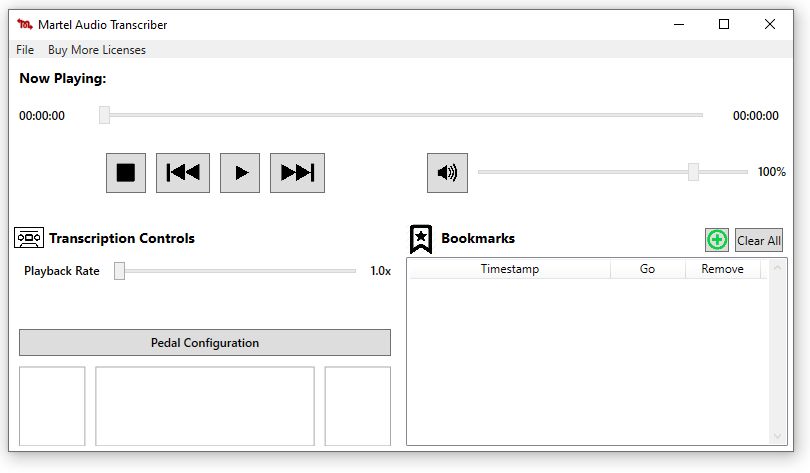
Use the Martel All N One transcription software when you are evaluating the software-download option. Compare the All N One transcription kit if the reviewer also needs a foot pedal and listening equipment. Confirm that the supplied recording is supported in the intended release. The audio player and the document workflow have different jobs, and the handoff needs both. A software purchase by itself cannot decide who has authority to accept disputed wording.
An original, fictional job you can review without client material
For this guide we wrote a five-turn scene at a fictional Maple Hall meeting and rendered it with synthetic voices. We kept the script and generated audio together, measured the turn boundaries from the actual audio segments, and constructed a deliberately flawed draft and corrected review copy. The exercise is a summary of the relevant facts in the recording. It is not an official transcript or an account of a proceeding. You can use the printed script and the sample revisions as a training exercise even when you are not working with the example audio.
The chair opens a practice log and gives the start time. The clerk reports counts and locations for two groups of folders. The chair changes one April date while preserving another. The clerk reads a carton label but gives no entrance description. The chair then assigns the revised draft to Morgan and tells the group to wait for figures to be reviewed before sending the working copy. A polished but inaccurate summary could sound entirely plausible. That is why each corrected fact must be connected to a particular source turn.
| Turn | Elapsed start | Elapsed end | Speaker | Detail to check |
|---|---|---|---|---|
| 1 | 0.500 s | 4.850 s | Chair | Maple Hall and the start time |
| 2 | 5.850 s | 11.025 s | Clerk | Fourteen green folders and forty blue folders |
| 3 | 12.025 s | 18.655 s | Chair | Delivery moves to April 28 and inspection stays April 18 |
| 4 | 19.655 s | 25.142 s | Clerk | Willow Gate carton label and unspecified entrance |
| 5 | 26.142 s | 32.032 s | Chair | Morgan receives the revision, and dispatch waits for review |
The complete reference runs approximately 33.03 seconds, including the opening and closing silence. These are elapsed positions in the generated practice WAV. The clock time spoken by the chair, nine fifteen, is information inside the meeting and has a different meaning. A reviewer looking for nine minutes and fifteen seconds on the recording has confused content with location. Agree on the reference before exchanging notes and include the recording identifier when more than one source is involved.
See how an error can look reasonable in a finished paragraph
The deliberately inaccurate practice draft begins, “The meeting began at 9:50.” It claims there were forty green folders and fourteen blue ones. Both numbers actually occur in the source, which makes this more difficult to spot than an obviously impossible count. The draft assigns both events to April 28, supplies a north entrance for Willow Gate and tells the reader to send the working copy before the figures are reviewed. Every sentence can be read fluently. Each contains a material detail that the source does not support.
Begin by separating the findings. The start time is one issue. The green-folder count and blue-folder count form a pair of linked details. The delivery date and inspection date form another pair, but for a different reason. One of those dates was explicitly revised, while the other stayed fixed. The entrance is a missing source fact that cannot be supplied by better spelling. Finally, the instruction before or after defines the order of a real action. Replacing a single word changes what someone would do.
These distinctions guide the second operator's listening. For the time, listen around the spoken start rather than replaying the whole meeting. For the counts, return to the sentence containing both colors and both storage locations. For the dates, include the first wording, its correction and the separate inspection instruction. For the entrance, check what the speaker actually says about its identity. For the final instruction, listen through the end of the phrase so the condition on dispatch is audible.
Give every material change a return address
A useful return address has three parts. It names the source item, gives a reliable location within that item and identifies the document passage under review. An elapsed time on its own becomes ambiguous when the reviewer opens an exported clip whose start differs from the original. A paragraph number on its own can change as the typist inserts a heading. A file named final is ambiguous as soon as a second final arrives in the review folder.
In the Maple Hall exercise an effective note for the inventory line is “Reference WAV, turn 2, about six seconds from its beginning. Compare the full clause about colors, quantities and locations with the second sentence of draft A.” That description gives the player operator a convenient place to begin and tells the document reviewer what matters. A note that says “check numbers” forces the second person to rediscover both the source and the question before they can help.
Use the office's normal identifier conventions for actual work. A compact training convention might identify the first source as MH-AUDIO-01, the received draft as MH-TEXT-A and the returned revision as MH-TEXT-B. These are invented identifiers for a teaching example. They have no special meaning outside this exercise. Within the exercise they make it possible to discuss a replacement file without disclosing matter names or relying on the order in which attachments appeared.
Review a number and its relationship to the surrounding nouns
A common numerical error survives because each individual number is present somewhere in the paragraph. In the folder example, checking whether the recording contains fourteen and forty is insufficient. The reviewer must put fourteen with green and the upper shelf, and forty with blue and the cabinet. Ask the listener to write each grouping on a separate line before looking again at the draft. A sentence can contain both correct numbers and still reverse their meaning.
Play a few words before the first quantity. Let the person hearing the source identify the speaker and the action being described. Then replay the entire quantity-and-location sentence at a comfortable speed. If the player supports a short review jump, use the word counted as a recognizable starting marker. Write the first grouping and the second grouping without a guess about why the typist exchanged them. An error in the draft can be corrected without assigning blame for how it happened.
For a real office handoff, make the correction reversible through the normal document version history or a retained received revision. The reviewer returns an explanation that another person can check, such as “Turn 2 pairs fourteen with green.” Avoid replacing the number everywhere through a global document change. In this short practice recording forty is correct in one location. A global substitution would repair one error and create another, a surprisingly easy mistake when a reviewer is pressed for time.
Treat an explicit correction differently from an uncertain word
The chair initially speaks April eighteenth as a delivery date and then instructs the group to use April twenty-eighth. The inspection date stays the eighteenth. An assigned summary should reflect the final delivery date and the unchanged inspection date. A verbatim assignment might preserve the original wording and its correction. The same source can therefore lead to two different legitimate documents depending on the instructions. Agree which one you are producing before accusing a typist of dropping spoken words.
The practice reviewer should make two entries. One records the final delivery decision. The other confirms that the change did not spread to the inspection. If you write only “changed date to April 28,” the next reader has to infer what happened to the second date. This is especially important for a document used to coordinate real work. One unsupported extension of a correction can send a person to the wrong place or day even when the revised date itself was heard accurately.
A simple check is to ask the reviewer to read back the task as an instruction to someone who was absent. In this fictional example a recipient should understand when the delivery takes place and when the inspection occurs. If reading the revised sentence still leaves open which event moved, the wording needs work. Replay the section that resolves the relationship before adjusting the prose. Good review protects both fidelity to the source and the reader's ability to understand it.