In this guide
- Start the storage conversation at the review desk
- Read a Martel package description in units that mean something
- A small, measured file-recovery exercise
- Give the exercise a separate, approved destination
- Separate content identity, completeness and playability
- Design a request that tests retrieval as well as copying
- Time the whole handoff and the individual stages
- Use measured files to discuss capacity
- Identify which question a RAID configuration answers
- Compare three ways an otherwise plausible drill can fail
- Include the person who works at shift change
- Write the conclusion at the level the evidence supports
- Give a second reviewer enough information to repeat the request
- Read a timing sheet without hiding a long wait
- When an authorized export differs from the archived file
- Make the storage discussion useful to a buyer comparing quantities
- Maintain the ability to repeat the drill after a change
- Practical questions and answers
A storage proposal is more useful when the people who will receive video can describe a complete recovery. Choose a harmless training file, identify the agency-approved copy intended for restoration and give an authorized reviewer a separate location at which to reopen it. The exercise can be run without changing or deleting original material. A successful restoration tells you something specific about the tested sample, destination and permissions.
Start the storage conversation at the review desk
An agency evaluating an on-premises body camera system needs to know what happens when an authorized employee requests a particular recording. Imagine asking for a harmless training clip identified by unit, session and a spoken marker. Who receives the request? How do they identify the correct authorized copy? At what workstation can the reviewer open it? Those questions are answerable with a practical demonstration long before anyone needs to discuss a real incident.
There are several different achievements along that journey. The camera made a file. The receiving system obtained it. The agency created whatever protected copy its approved policy requires. A reviewer could recover a selected item from that copy. Finally, the reviewer could open and use it in the intended environment. A successful check at one stage gives valuable information about that stage. Staff should be able to point to the stage they tested without implying that every later stage succeeded.
This guide uses a small original file exercise whose outcomes can be stated exactly. We generated invented data, copied it between separate directories in one test environment and checked the restored bytes. That is a limited demonstration of file identification and comparison. The guide then shows how an agency can apply the questions to its own authorized storage equipment. The actual architecture, independence of protection, restore time and player behavior must be checked at the agency's installation.
Read a Martel package description in units that mean something
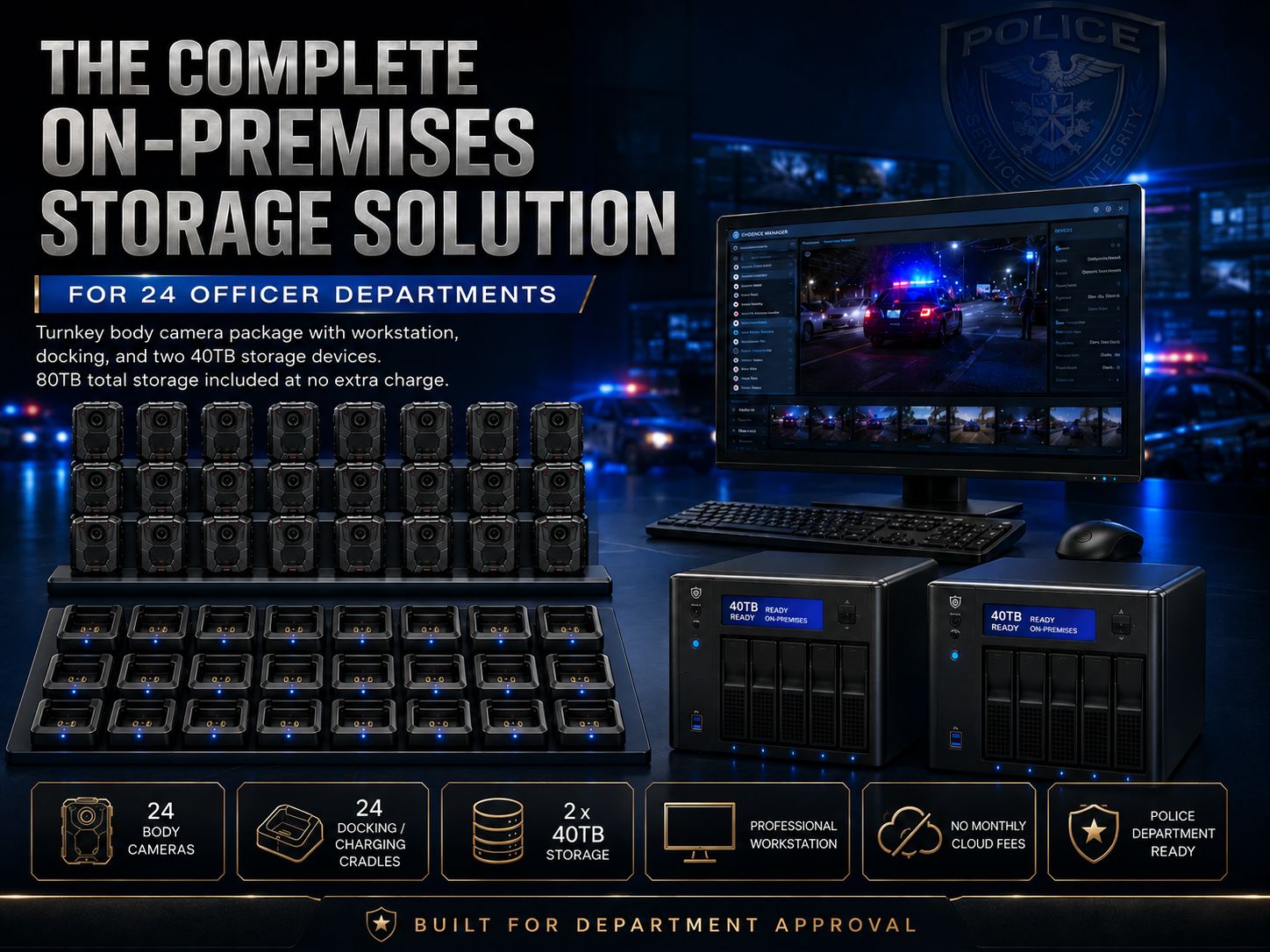
The six-camera package lists a workstation and two 24 TB RAID storage devices. The twelve-camera package also lists two 24 TB RAID storage devices. The twenty-four-camera package lists two 40 TB RAID storage devices. These descriptions establish the listed hardware quantities, subject to the written configuration actually purchased.
Do not immediately convert two 24 TB device descriptions into a retention or recovery promise. Ask whether the quoted figure refers to installed capacity, usable capacity under a specified arrangement or capacity available for some particular purpose. Ask where primary files reside, how the approved independent copy is produced and what system or location would be used if the everyday receiving workstation were unavailable. Two devices in the same location can also share dependencies such as power, access or administration.
Compare the six- and twelve-camera descriptions carefully. Camera count changes, yet both cited packages describe the same number and size of RAID devices. That makes the agency's workload assumptions especially important. A twelve-camera deployment that records many more hours creates a different storage requirement even when the device labels match. Conversely, a larger pool of cameras that hosts only a smaller group of active users at a time may have a different daily volume. Base the calculation on representative files and the agency's actual authorized requirements.
A small, measured file-recovery exercise
We created two fictional text files and one original practice WAV. The text files differ in a three-digit marker. One says BLUE 249 and the other says BLUE 294. Both are exactly 51 bytes long. We placed a copy of each original in a second directory and restored it into a third directory. We then calculated the SHA-256 digest of each original file and its restored counterpart. All three pairs matched in the exercise.
| File in the practice dataset | Size | First 12 hexadecimal characters of its SHA-256 digest | Observed result |
|---|---|---|---|
| First text, marker BLUE 249 | 51 bytes | e1435fe75492 | Original and restored full digests matched |
| Second text, marker BLUE 294 | 51 bytes | 4082fa13768a | Original and restored full digests matched |
| Generated stereo practice WAV | 768,044 bytes | 225d1075e147 | Original and restored full digests matched |
The shortened prefixes make the examples easier to identify on the page. The comparisons used the full digests. We also opened the restored audio file programmatically, read its header and confirmed a twelve-second length, two channels and a sample rate of 16,000 Hz. That check says what the file reports and that the file could be read with the software used for this exercise. We did not run this exercise on a Martel camera, RAID device or agency review player.
Why include two tiny text files with different markers? Because a reviewer who checks only the file size can accept the wrong item with complete confidence. Both text files have the same length, and their names can look similar at a glance. The marker and digest distinguish them. In a real approved system, identifiers and records can be more involved. The principle is the same. Decide what identifies the requested item before declaring success at the moment a file appears in a folder.
Give the exercise a separate, approved destination
Choose a clearly identified training location that the responsible administrator has approved for the restore. Give the training files names that cannot be mistaken for operational records. Confirm that the operator has the authority to perform the test and that using a separate destination is supported by the actual system. A test of recovery should protect the originals and the approved protected copies from accidental replacement.
Write down which item the reviewer is asking for without telling the operator exactly where someone already found it. The request might be “Return the authorized BLUE 249 practice record and the reference audio for the same exercise.” The receiving team should use its documented recovery route. If the operator simply copies the everyday working file they already have open, the test establishes that a local copy can be made. It leaves the availability of the intended protected copy unanswered.
After the recovered item reaches the test location, ask the assigned reviewer to open it through their normal approved process. Use the expected viewer or player. In the small exercise a text marker and audio header supply objective checks. For an agency video example, use a permitted marker, expected duration and a short sample the reviewer can identify. Record the source, destination and application. A system administrator's ability to list file names is not equivalent to a records employee's ability to deliver the reviewed item.
Separate content identity, completeness and playability
File identity is about whether the returned object is the object requested. A full content comparison supports byte-for-byte agreement between two identified copies. Completeness is about whether the identified source contained everything the agency expected to obtain. A perfectly matched restored copy of a truncated original is still truncated. Playability is about whether the authorized recipient can actually open and review that object with the approved application and permissions.
In the practice exercise, imagine that someone requested the BLUE 249 text but received a flawless restoration of BLUE 294. The restore process could have copied the selected item accurately while the request was fulfilled incorrectly. Conversely, the selected BLUE 249 source might be correct while the destination contains an incomplete or altered file. A single green check mark cannot distinguish these cases. Use a separate row for request identity and for integrity of the selected copy.
A comparable distinction arises with the audio file. A correct header and matching digest provide evidence about identity and file structure. They cannot establish that the agency's actual review workstation has the appropriate authorized application, or that the intended human listener can navigate to the required time. Add that step to a deployment exercise. Ask the reviewer to show the requested marker and report which source and playback position they used. That gives the handoff a practical, observable finish.
Design a request that tests retrieval as well as copying
A good first request is narrow enough that the reviewer can independently identify the intended item. Use a permitted training date or session number, neutral device label and one content marker. Avoid assuming that the original filename will always be the way a user searches. If the agency's normal system locates recordings through a catalog or case reference under a prescribed process, use that supported route. Record any other authorized employee who must participate.
For a more informative second request, introduce an intentionally similar item in the training set. Two samples can have the same length, device label or broadly similar file names while differing in a harmless detail. The reviewer must return the requested one and explain how it was identified. In our exercise BLUE 249 and BLUE 294 differ by an easy-to-transpose pair of digits. A practice request that tests this distinction is more revealing than opening the only file in an otherwise empty folder.
Use an explicit observation for a no-result search. For example, “The reviewer could see the training session but could not identify which authorized copy contained marker 249.” That describes a discovery or metadata issue. It does not establish that the bytes were lost. A separate report might read “The requested copy was identified, but the approved restore operation did not complete.” Staff can take those two reports to different owners without guessing which part of the process needs attention.
Time the whole handoff and the individual stages
Before starting a local trial, agree when the clock begins and ends. The administrator measuring only the copy operation and the supervisor measuring the time until the authorized reviewer can play the requested marker are both collecting useful data. They are measuring different intervals. A purchasing decision about service capacity may depend on the second number, particularly if identifying the permitted copy or arranging authorized access takes longer than copying the bytes.
Use a simple event record. The request was received. The correct source was identified. Retrieval began. The restored file arrived in the approved test location. Integrity checks completed. The intended reviewer opened the item and checked the marker. Record actual times against those events. A blank field means the event was unmeasured or did not occur. Avoid assigning an assumed duration to fill an empty cell.